There is nothing quite like the specific dread of opening a closet door and having to catch a falling stack of sweaters before they hit the floor. It’s a morning ritual for way too many folks here in Savannah, especially given that many of our beautiful historic homes were built back when people owned about three outfits total. But here’s the thing—you usually don’t need a bigger house; you just need to rethink the empty box you’re currently shoving your life into.
The Vertical Advantage: Look Up, Not Out
We need to talk about the space above your head. Most standard closets, the kind you find in typical builder-grade setups, have a single shelf with a rod underneath it, sitting maybe five or six feet off the ground. If you live in one of those gorgeous Victorian places downtown or even a mid-century ranch in Ardsley Park, you likely have ceilings that go much higher than that.
By ignoring that upper real estate, you are wasting feet—not inches, feet—of prime storage.
The secret isn’t magic; it’s geometry. We move that top shelf up. Way up. In a closet renovation, we can install a high shelf specifically for out-of-season items. You know, the heavy coats you only need for those two weeks in January when Savannah actually freezes over, or the holiday decorations that clutter up the floor the rest of the year.
Honestly, getting those bins off the floor makes the room feel twice as big instantly. It draws the eye upward and clears the clutter at your feet. It’s about creating “zones.” The “I need this every day” zone is eye-level. The “I’ll see you next Christmas” zone is near the ceiling.
The Magic of the Double Hang
This is probably the single most effective trick in the handyman playbook, yet so many people hesitate to do it. If you mostly wear shirts, blazers, or pants folded over a hanger, you are wasting a massive amount of vertical space with a single rod.
Here is a hard truth: Single rods are inefficient.
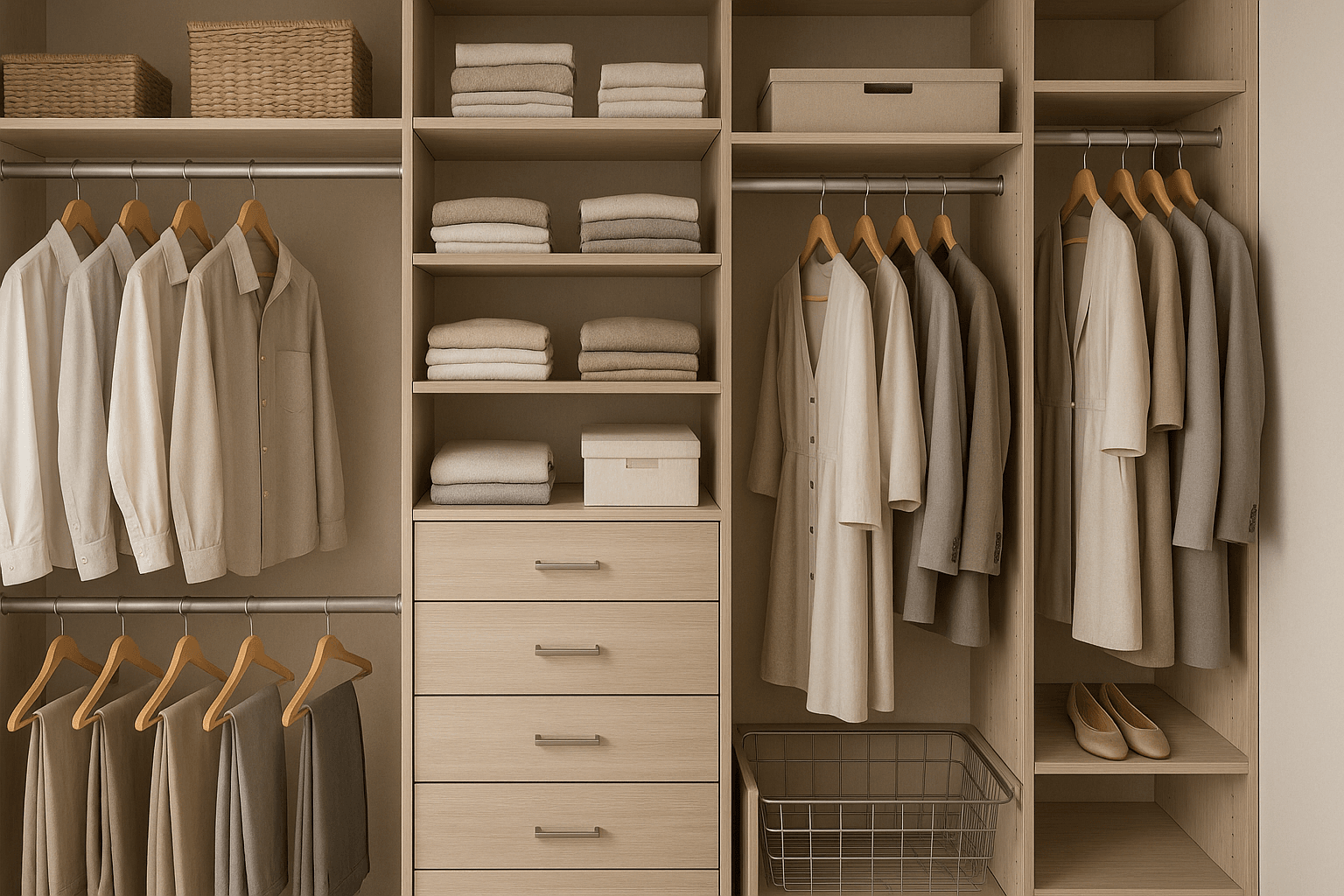
Unless you have a closet full of floor-length evening gowns (and if you do, good for you!), you should be doubling up. We simply take out that single rod and install two: one high, one low. Boom. You just instantly doubled your hanging storage without knocking down a single wall.
You might be thinking, “But won’t my clothes drag?” Not if we measure it right. A standard shirt hangs down about 36 to 40 inches. If we set the top rod at 84 inches and the bottom one at 42 inches, you have plenty of clearance. This is a staple of custom closet organization that changes the game for shared closets especially.
A Quick Note on “Long Hang” Sections
We don’t have to double-hang the whole thing. We usually leave a small section, maybe 12 to 18 inches wide, with a single high rod. That’s for your sundresses, jumpsuits, or long coats. It’s about tailoring the space to what you actually own, not what the house builder thought you might own.
Lighting: It’s Not Just for Vanity
Have you ever tried to distinguish navy blue slacks from black slacks in a dark closet at 6:00 AM? It’s a gamble. Most closets here in Savannah have one dim bulb in the center of the ceiling, usually covered by a dusty glass dome that blocks half the light.
Proper lighting isn’t just aesthetic; it’s functional. When you can see the corners, you use the corners.
We are seeing a huge shift toward motion-sensor LED strips. These are fantastic. We run them along the door frame or right above the hanging rods. The moment you open the door, the whole space lights up. No more fumbling for a pull cord or wondering if you’re wearing matching socks. Plus, LEDs run cool. In our humid climate, the last thing you want is an incandescent bulb heating up a small, enclosed space. That’s a recipe for musty smells or, worse, damage to delicate fabrics.
The “Dead Space” Behind the Door
Let’s chat about the door itself. Whether you have a swing door or a bi-fold, the back of that door (or the wall directly behind it) is often a graveyard of wasted potential.
If you have a standard swing door, that is prime real estate for:
- Shoe racks (get them off the floor!)
- Belt and tie organizers
- Hooks for robes or the outfit you plan to wear tomorrow
If you have those sliding doors that bypass each other, they can be a nightmare because you can never see the whole closet at once. Sometimes, if the room allows, we recommend switching those out for French doors or even a pocket door if you’re doing a larger remodel. It allows full access to the closet shelving installation, ensuring nothing gets lost in the abyss of the “middle overlap.”
Wire Racks vs. Solid Shelving
We need to address the elephant in the room: wire shelving. You know the stuff. It’s white, sticky, leaves grill marks on your sweaters, and eventually pulls out of the drywall when you load it down with too much denim.
Builders love it because it’s cheap. Homeowners usually hate it.
Replacing wire racks with solid wood or melamine shelving is the single best upgrade you can make for the longevity of your clothes and your sanity. Solid shelves prevent small items from falling through. They look cleaner. And frankly, they are stronger.
Here is a quick breakdown of why we usually steer folks toward solid setups:
| Feature | Wire Shelving | Solid Wood/Melamine |
|---|---|---|
| Durability | Prone to bending and sagging | Sturdy, holds heavy loads |
| Clothes Care | Can snag fabrics or leave lines | Smooth surface, safe for knits |
| Aesthetics | Looks temporary or “cheap” | Looks built-in and finished |
| Adjustability | Difficult to reconfigure | Can be built on adjustable tracks |
Don’t Forget the Humidity
This is a Savannah-specific tip. Our air is heavy. If you pack a closet too tight, air can’t circulate. When air doesn’t circulate in a dark place, you get mildew. It’s gross, but it’s real.
A good handyman knows that closet ventilation matters. We often suggest installing louvered doors (the ones with the slats) rather than solid doors to keep air moving. Or, if we are building custom shelves, we leave a small gap at the back or sides. It’s a tiny detail that you might not notice visually, but your nose will definitely thank you after a long, humid summer.
The “Custom” Look on a Budget
You don’t always need a $10,000 custom cabinetry system to get organized. Sometimes, it’s about mixing store-bought modular systems with custom handyman touches.
For example, we can take a standard dresser that you already own, shove it into the closet (if space permits), and anchor it to the wall. Then, we build shelving around it. It creates the look of a built-in unit for a fraction of the cost. It’s all about being clever with the materials. We cut trim pieces to fill the gaps, caulk the seams, and paint it all to match. Suddenly, that IKEA dresser looks like it was custom-made for your home in 1920.
Finding Hidden Depth
Older homes are notorious for having closets that are shallow but wide, or deep but narrow (the “tunnel” closet).
For the shallow ones, we have to get creative with hanging depth. If a standard hanger sticks out too far, we might install a valet rod that pulls out, allowing you to hang clothes facing forward rather than sideways.
For the tunnel closets, the back wall is usually a black hole. We often install deep shelving back there for bins, and keep the hanging rods toward the front. It’s about knowing your reach. If you have to crawl into the closet to get a shirt, you aren’t going to wear that shirt. We want everything accessible.
It’s Time to Reclaim Your Mornings
We get it. It feels like a small thing—it’s just a closet, right? But starting your day fighting with a jammed hanger or tripping over a pile of shoes sets a chaotic tone for everything else. You deserve a space that works for you, not against you.
Whether you need a quick repair on a broken rod, a switch from wire to wood, or a full reconfiguration of your storage space, Savannah Handyman has the tools and the know-how to get it done right. We know these local homes inside and out, and we know how to squeeze every inch of utility out of them.
Stop letting that messy closet boss you around. Let’s get it fixed.