There is something about walking into a room finished with crisp, elegant crown molding that just makes the whole space feel complete. It draws the eye upward, adding a touch of Southern sophistication that fits right in with our historic Savannah architecture and charm. But if you’ve ever tried to install it yourself, you know that “simple weekend project” can turn into a headache fast.
Contents
- 1 Why Crown Molding is Deceptively Difficult
- 2 The “Savannah Factor”: Dealing with Wonky Walls
- 3 Coping vs. Mitering: The Secret Weapon
- 4 Choosing the Right Material for the South
- 5 The Difference is in the Details
- 6 Why You Should Stop Stressing and Call a Pro
- 7 It’s an Investment in Your Home
- 8 Let’s Transform Your Space
Why Crown Molding is Deceptively Difficult
Honestly, it looks so easy on TV. You see them measure, cut, pop it on the wall, and boom—instant luxury. But here’s the thing they don’t tell you: your house isn’t a TV set. It’s a living, breathing structure, and in Savannah, it’s probably an older one that has settled over time.
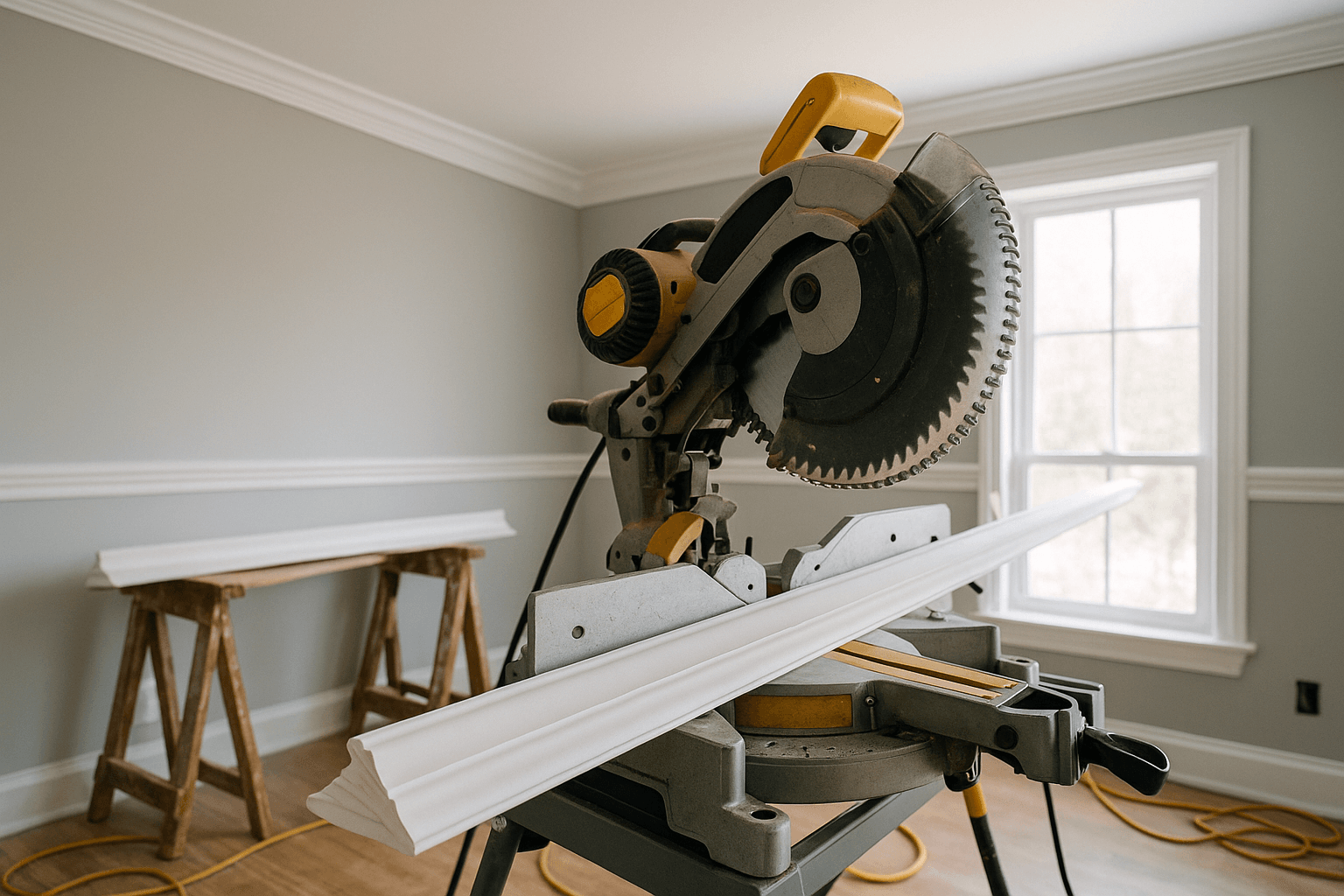
When you start messing around with crown molding, you quickly realize that geometry class was a long time ago. You aren’t just cutting 45-degree angles. You are dealing with compound angles. The molding sits against the wall and the ceiling at a slant, which means your saw blade has to be tilted and turned at the exact right degrees simultaneously.
If you get it wrong by even a fraction of a degree, the corners won’t meet. You end up with these awkward, gaping holes that stare back at you. Sure, people joke about “caulk and paint make it what it isn’t,” but there is only so much caulk can hide before it looks like a patchy art project.
The “Savannah Factor”: Dealing with Wonky Walls
Let’s be real for a second. We love our homes here in Georgia, but perfectly square rooms just don’t exist. Whether you’re in a new build in Pooler or a historic gem downtown, walls bow, ceilings wave, and corners are rarely a perfect 90 degrees.
A professional crown molding handyman expects this. We don’t fight the house; we work with it.
When an amateur tries to force a stiff board against a wavy wall, you get gaps. Shadows appear behind the molding, ruining that seamless look you were going for. A pro knows how to scribe the molding—shaving off tiny bits of the wood’s back edge—so it hugs the contours of your wall perfectly. It’s a subtle skill, kind of like tailoring a suit. You might not notice the work that went into it, but you definitely notice how good it looks.
Coping vs. Mitering: The Secret Weapon
You know what separates a true craftsman from a weekend warrior? It’s usually the joints. Most homeowners try to cut two 45-degree angles and mash them together in the corner. That’s called a miter joint. It works great for picture frames, but for walls? Not so much.
As the wood expands and contracts with our Savannah humidity, those miter joints are the first things to pop open.
A skilled handyman uses a technique called coping. instead of just cutting an angle, we take a coping saw—a little hand saw with a thin blade—and manually carve out the profile of the molding on one end. This allows one piece to slide right over the face of the adjacent piece. It fits like a puzzle.
Why does this matter?
- Tight fit: Because one piece overlaps the other, the joint stays tight even if the corner isn’t perfectly square.
- Durability: When the house shifts or the wood shrinks in winter, a coped joint hides the movement much better than a mitered one.
- Visuals: It looks crisp, clean, and continuous.
Choosing the Right Material for the South
This is another area where things get tricky. You walk into the big box store, and there are rows of white stuff. It all looks the same, but it behaves very differently.
- MDF (Medium Density Fiberboard): It’s smooth and paints up beautifully. However, it acts like a sponge. If you have a humidity issue or a roof leak, MDF swells up like a balloon.
- Solid Wood (Pine or Poplar): Traditional and sturdy. It holds crisp details, but it can warp if not acclimated properly to your home’s temperature before installation.
- Polyurethane: Lightweight and impervious to rot. It’s great, but it can be tricky to install because it’s a bit floppy compared to wood.
A local handyman can look at your specific room—is it a bathroom with steam? A sunroom with temperature swings?—and tell you exactly which material will last. We aren’t just selling you wood; we are selling you longevity.
The Difference is in the Details
It’s easy to focus on the cutting, but the installation is only half the battle. The finish work is what actually makes the molding look like part of the house rather than something tacked onto it.
| Feature | The DIY Approach | The Savannah Handyman Way |
|---|---|---|
| Nailing | Nails often miss studs, leading to loose molding. | We use stud finders and cross-nailing techniques to lock it in tight. |
| Joints | Often simple miters that separate over time. | Coped joints and scarf joints (for long runs) that stay seamless. |
| Caulking | messy beads of caulk that yellow or crack. | smooth, paintable lines that disappear into the trim. |
| Tools | Basic miter saw and a hammer. | Compound sliding miter saws, pneumatic nailers, and coping saws. |
Why You Should Stop Stressing and Call a Pro
Look, I’m all for DIY projects. Fixing a leaky faucet or painting a bedroom is great. But crown molding is high-stakes carpentry. It’s expensive material, and if you mess it up, you can’t just erase it. You have to buy more wood.
There is also the safety aspect. You’re up on a ladder, wrestling with 12-foot lengths of lumber, trying to hold it against the ceiling with one hand while operating a nail gun with the other. It’s physically exhausting.
Hiring a crown molding handyman saves you:
- Time: What takes you three weekends takes us a day or two.
- Money: No buying expensive saws you’ll use once. No wasting expensive trim on bad cuts.
- Sanity: You avoid the “I told you we should have hired someone” arguments with your spouse.
Plus, we handle the cleanup. No sawdust coating your living room furniture.
It’s an Investment in Your Home
You might think of hiring help as an expense, but really, professional trim work is an investment. High-quality molding increases the perceived value of your home. It makes ceilings look higher and rooms look grander. When it’s done right, nobody looks at it and thinks “nice molding.” They just look at the room and feel that it’s high-quality.
On the flip side, bad molding stands out like a sore thumb. Gaps, uneven lines, and visible nail holes catch the eye immediately and make the whole room feel a bit… cheap. And nobody wants that.
So, if you are staring at your ceiling imagining how good it could look, let’s make it happen. You don’t need to learn advanced geometry or buy a $600 saw. You just need someone who knows the tricks of the trade and cares about the finish as much as you do.
Let’s Transform Your Space
Don’t let the fear of complex cuts keep you from having the home you want. At Savannah Handyman, we have the tools, the patience, and the local know-how to handle everything from standard crown to intricate, multi-piece build-ups. We treat your home like it’s our own, ensuring every corner is crisp and every joint is invisible.
Ready to add that “wow” factor to your living room or dining area? Let’s get started.